Posts

Showing posts with the label Artificial Intelligence

The case for Fast Transforms as Averaging Machines

Image
Are Fast Transforms like the FFT and Walsh Hadamard transform averaging machines? Certainly there is an all sum term such as A+B+C+D+E+F+G in the diagram which can be considered an average especially after vector length renormalization where all the output terms would typically be multiplied by 1/sqr(width), 1/sqr(8) in this case, to leave vector magnitude unchanged by the transform. For a different input, say {+1,+1,-1,-1,-1,-1,+1,+1] the output term A+B-C-D-E-F+G+H becomes 1+1+1+1+1+1+1+1.  For that input pattern that particular output term becomes an averaging operation. Degrees of freedom For standard averaging of n values many different combinations of values can result in the same average. There are many degrees of freedom. As you start demanding more and more output terms of a fast transform be particular values the degrees of freedom in the input shrink. Until, when you demand all the outputs be particular values, then only one exact input vector will give that result. To g...

Switch Net 4 (Switch Net N) Combine multiple low width neural layers with a fast transform.

Image
 Switch Net 4  Switch Net 4. Random sign flipping before a fast Walsh Hadamard transform results in a Random Projection. For almost any input the result is a Gaussian distributed output vector where each output element contains knowledge of all the input elements. With Switch Net 4 the output elements are 2-way switched using (x<0?) as a switching predicate. Where x is the input to the switch.  The switches are grouped together in units of 4 which together form a small width 4 neural. When a particualr x>=0, the pattern in the selected pattern of weights is forward projected with intensity x. When x<0 a different pattern of forward selected weights is again projected with intensity x (x being negative this time.) If nothing was projected when x<0 then the situation would be identical to using a ReLU. You could view the situation in Switch Net 4 as using 2 ReLUs one with input x and one with input -x.  The reason to 2-way switch (or +- ReLU) is to avoid ea...

ReLU as a Switch

Image
 ReLU as a Switch The conventional view - ReLU as a function ReLU as a function. ReLU as a Switch A slight confusion in computer science is that switches are purely digital, from switching gates and such. That appears to be the case because the supply voltage is fixed and that is the only thing switched. However a light switch in you house is binary on off, yet connects or disconnects an AC sine wave voltage.  A switch therefore is a mixed digital analog device. When on, the input signal goes through 1 to 1. When off, the output is zero. You can then view ReLU as a switch that is 1 to 1 when on and output zero when off. Of course there is a switching decision to make.  In your house you make the switching decision for a light. With ReLU the switching decision is based on the predicate (x>=0)? Where x is the input to the switch. You could supply other predicates for the switching decisions if you wanted but switching at x=0 is very helpful for optimization. A ReLU netwo...

Random Projections for Neural Networks

Image
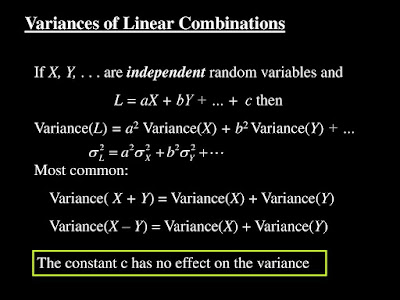
Random Projections for Neural Networks  Variance and the CLT For Linear Combinations of Random Variables a negative sign before a particular variable has no effect on variance. And of course the Central Limit Theorem is in operation. The Walsh Hadamard transform (WHT) is a set of orthogonal weighted sums (where the weights are +1 or -1 or some constant multiple of those.)  And so the variance equation for linear combinations of random variables applies (minus signs not invalidating that), as does the Central Limit Theorem. 8-Point Walsh Hadamard transform. Therefore applying the WHT to a sequence of random numbers from the Uniform random number distribution results in a sequence of numbers from the Gaussian (Normal) distribution. Example code is here: https://editor.p5js.org/siobhan.491/sketches/WhoxMA7pH If you want to use that behavior to generate Gaussians you should remember that the WHT leaves vector magnitued (length) unchanged (except by a constant c.)  The result ...

Switch Net 4 - reducing the cost of a neural network layer.

Image
 Switch Net 4 The layers in a fully connected artificial neural network don't scale nicely with width. Width of a neural network. For width n the number of multiply add operations required per layer is n squared. For a layer of width 256 the number multiply adds would be 65536 (256*256.) Even with modern hardward layers cannot be made much wider than that. Or can they?  A layer of width 2 only requires 4 operations, width 4 only 16 operations, width 8 only 64 operations. If you could combine k width n (n being small) layers into a new much wider layer you'd end up with a computational advantage. For example 64 width 4 layers combined into a width 256 layer would cost 64*16=1024 multiply add operations plus the combining cost.  A combining algorithm. The fast Walsh Hadmard transform can be used as a combiner because a change in a single input causes all the outputs to vary. The combining cost is n*log2(n) add subtract operations. For a layer of width 256 the combining cost...

GPT-4 Songs

Image
 GPT-4 Songs And perhaps talking directly to OpenAI

2 Siding ReLU via Forward Projections

Image
2 Siding ReLU via Forward Projections The ReLU acivation function in neural networks has special properties that allow it to be considered in a different way to other activation functions. The Switching Viewpoint You can view ReLU as being non-conducting when x<=0 and fully conducting when x>0.  It is a switch which is automatically turned on when x>0 and automatically turned off when x<=0. Which is an ideal rectifier in electrical engineering terms.  Hence the term  Rectified Linear Unit. A switch isn't there when it is on from the point of view of the flowing electricity (or analogous thing.)  Electricity flows through pushed together switch contacts the same as through the wires to the switch.  All the ReLUs in a neural network that are conducting, wire together various sub-components of the network. The wiring being complete the ReLUs become essentially invisible, until one or more ReLUs change state. Since neural networks are computed in a ...