Posts

Showing posts with the label Distribution

Subrandom Projections
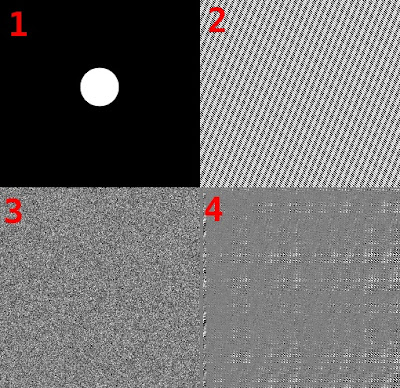
Image
Subrandom Projections Performing random sign flips on natural data like images before many types of fast transform such as the FFT or WHT gives Gaussian noise outputs.  Essentially the sign flips convert the input data to a collection of random variables that then get weighted, summed and differenced by the fast transform giving Gaussian noise by the Central Limit Theorem. Another way of stating the situation is that random sign flips combined with fast transforms create Random Projections (RPs) of the input data. While such RPs have many uses there are some disadvantages such as the complete loss of direct rotation, scaling and translation (RST) information about objects in the orignal image.  It would be nice if some of that RST information was kept along with some of the nice information distribution properties of Random Projections. One solution to the problem is to use subrandom (low discrepancy) numbers to decide the sign flips. For example, Additive Recurrence based Sub...
Random Projections for Neural Networks

Image
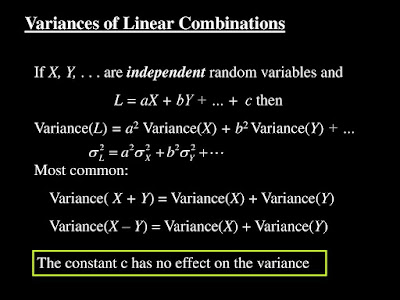
Random Projections for Neural Networks  Variance and the CLT For Linear Combinations of Random Variables a negative sign before a particular variable has no effect on variance. And of course the Central Limit Theorem is in operation. The Walsh Hadamard transform (WHT) is a set of orthogonal weighted sums (where the weights are +1 or -1 or some constant multiple of those.)  And so the variance equation for linear combinations of random variables applies (minus signs not invalidating that), as does the Central Limit Theorem. 8-Point Walsh Hadamard transform. Therefore applying the WHT to a sequence of random numbers from the Uniform random number distribution results in a sequence of numbers from the Gaussian (Normal) distribution. Example code is here: https://editor.p5js.org/siobhan.491/sketches/WhoxMA7pH If you want to use that behavior to generate Gaussians you should remember that the WHT leaves vector magnitued (length) unchanged (except by a constant c.)  The result ...